
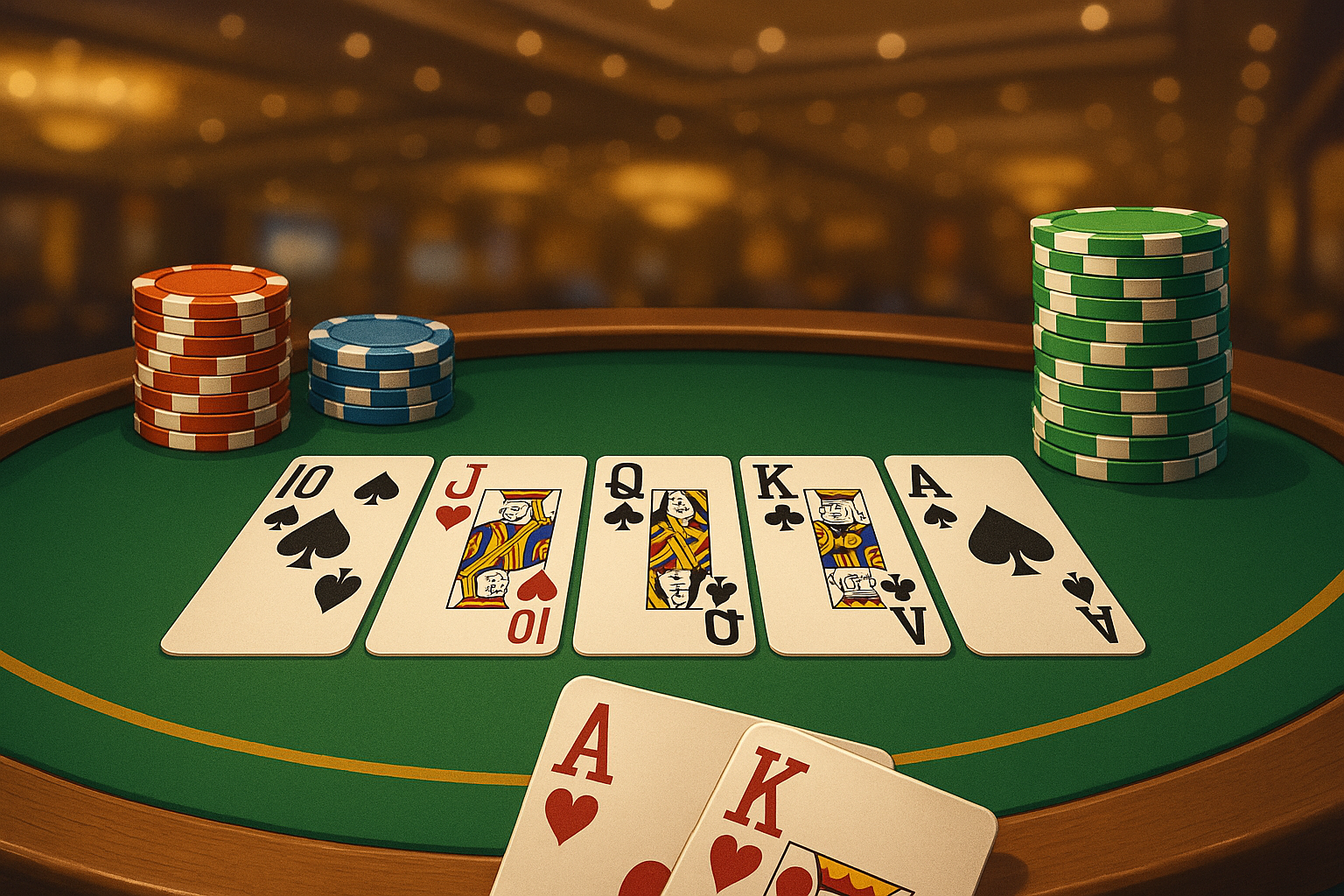
The poker casino game, especially Texas Hold’em, is the king of skill-based gambling. Unlike pure luck games, poker lets you use strategy, psychology, and math to gain an edge over other players. That’s why it’s the main event in live casinos, home games, and online poker rooms worldwide.
This guide explains how Texas Hold’em works, the hand rankings, betting rounds, and simple strategies to help you play smarter and avoid common beginner mistakes.
What Is the Poker Casino Game (Texas Hold’em)?
In Texas Hold’em:
- You compete against other players, not the house.
- Each player receives two private cards (hole cards).
- Five community cards are dealt face up in the middle of the table.
- You make the best five-card poker hand using any combination of your two hole cards and the five community cards.
The casino makes money by:
- Taking a small commission (the rake) from each pot, or
- Charging a tournament entry fee.
Your goal is to win chips from other players by making better hands or forcing them to fold.
Poker Hand Rankings (From Highest to Lowest)
Before you play, you must know the basic hand rankings used in most poker casino games:
- Royal Flush – A, K, Q, J, 10 of the same suit
- Straight Flush – Five cards in sequence, same suit (e.g., 5-6-7-8-9 of hearts)
- Four of a Kind – Four cards of the same rank (e.g., 9-9-9-9-x)
- Full House – Three of a kind + a pair (e.g., K-K-K-7-7)
- Flush – Any five cards of the same suit, not in order
- Straight – Five cards in sequence, mixed suits
- Three of a Kind – Three cards of the same rank
- Two Pair – Two different pairs
- One Pair – Two cards of the same rank
- High Card – None of the above; highest card wins
In Texas Hold’em, the pot is awarded to the player with the best five-card hand at showdown, or to the last remaining player if all others fold.
How a Texas Hold’em Poker Hand Works
A typical hand in the poker casino game follows these steps.
1. Blinds
Instead of antes from every player, Texas Hold’em uses blinds:
- The player to the dealer’s left posts the small blind.
- The next player posts the big blind (usually double the small blind).
These forced bets build the pot and create action.
2. Hole Cards (Preflop)
Each player receives two private cards face down:
- Starting with the player to the left of the dealer.
- You look at your hole cards and decide whether to play.
The first betting round (preflop) begins:
- Starting from the player to the left of the big blind.
- Options: fold, call (match the big blind), or raise.
Action continues clockwise until all remaining players have put in the same amount or folded.
3. The Flop
Three community cards are dealt face up in the middle of the table. This is called the flop.
Now you can see:
- Your two hole cards, plus
- Three community cards (first 3 of 5 shared cards).
Second betting round:
- Starts with the first active player to the left of the dealer.
- Options: check (if no bet yet), bet, call, raise, or fold.
4. The Turn
A fourth community card (the turn) is dealt face up.
Third betting round:
- Similar actions: check, bet, call, raise, fold.
- Pots often grow larger here as hands become more defined.
5. The River
A fifth and final community card (the river) is dealt face up.
Final betting round:
- Players now see all five community cards.
- Everyone knows the complete board and can evaluate how strong their hand is relative to possible opponent hands.
6. Showdown
If two or more players remain after the final betting round:
- All active players reveal their cards in showdown.
- Best five-card hand wins the pot.
- If all others fold at any point, the last remaining player wins without showing cards.
Basic Texas Hold’em Positions
Position is critical in the poker casino game:
- Being “on the button” (dealer position) means you act last on post-flop streets, giving you more information.
- Early positions (just after the blinds) act first and have less information, so you must play tighter.
- Late positions (button and cutoff) act last and can play wider ranges of hands thanks to better information.
As a beginner, simply remember:
- Play fewer hands in early position.
- Play more hands in late position when you can see what others do first.
Starting Hand Guidelines for Beginners
You don’t need a complex chart to get started. Use these simple rules:
Strong Hands to Play Almost Always
Raise or call with:
- Big pairs: AA, KK, QQ, JJ, TT
- Strong broadway cards: AK, AQ, AJ, KQ (suited is even better)
Medium Strength Hands to Play in Good Position
In late position, you can also play:
- Middle pairs: 99–66
- Suited connectors: J10s, 10-9s, 9-8s
- Ace with good kicker: A10s, AJs, AQs
Avoid weak hands like:
- Random low cards (e.g., 7-2 offsuit)
- Offsuit garbage hands (e.g., J4o, 10-3o)
Folding weak hands preflop saves you money and simplifies decisions post-flop.
Simple Strategy Tips for the Poker Casino Game
You don’t have to be a pro to win more often than pure beginners. These basics go a long way.
1. Play Tight, Aggressive
A classic beginner strategy:
- Tight: Play fewer, better starting hands.
- Aggressive: When you enter a pot, raise or bet, rather than just calling.
This approach:
- Gives you stronger average hands than most recreational players.
- Lets you win pots with both the best hand and with pressure when opponents fold.
2. Respect Position
- In early position, only play your strongest hands.
- In late position, you can open slightly more hands because you act last.
- Avoid calling raises out of position with marginal hands.
Good position makes post-flop decisions easier and more profitable.
3. Pay Attention to Bet Sizing
Common guidelines:
- Preflop raise size: roughly 2.5–3 times the big blind in cash games.
- Post-flop bets: often half to two-thirds of the pot.
Bet sizes communicate strength, apply pressure, and build pots when you have strong hands.
4. Don’t Chase Every Draw
Draws like:
- Flush draws (4 cards to a flush)
- Straight draws (4 to a straight)
…can be profitable if the pot odds are right. But calling big bets with weak draws can burn your stack quickly.
Rule of thumb:
- Call reasonable bets with strong draws and good odds.
- Fold weak draws facing large bets, especially out of position.
5. Avoid “Tilt”
Tilt is emotional, reckless play after a bad beat or losing streak:
- Over-bluffing
- Calling too much with weak hands
- Raising out of frustration
To combat tilt:
- Take a break after big losses.
- Set a stop-loss amount for each session.
- Remember that variance (up and down swings) is normal in the poker casino game.
Cash Games vs Tournaments
Texas Hold’em is played in two main formats.
Cash Games
- Chips represent real money.
- Blinds stay the same.
- You can buy in and leave whenever you like (within casino rules).
Cash games reward solid, steady play and good bankroll management.
Tournaments
- Everyone buys in for a fixed amount.
- You receive a starting stack of chips.
- Blinds increase over time.
- You play until you lose all your chips or reach the top places that pay prizes.
Tournaments have:
- Larger variance, but the chance for big payouts from small buy-ins.
- Different strategy, with more emphasis on survival and stack size.
Online vs Live Poker Casino Game
You can enjoy Texas Hold’em in both online and live environments.
Online Poker
- Faster: more hands per hour.
- Lower limits and more game variety.
- Great for practice and multi-tabling.
Live Poker (Casino or Card Room)
- Slower pace but more social.
- You can read physical tells, body language, and table talk.
- Good for players who enjoy the in-person casino atmosphere.
Both formats use the same basic rules; choose the one that fits your personality and schedule.
Bankroll Management for Poker
Because poker has variance, bankroll management is crucial:
- Keep a separate poker bankroll from your personal money.
- For cash games, a common guideline is at least 20–30 buy-ins for the stake you play.
- For tournaments (which are swingier), many players keep 50–100+ buy-ins.
Never play stakes where losing a few buy-ins will seriously affect your real-life finances.
Responsible Gambling
Even though poker is skill-based, it still involves risk:
- Do not play with money you cannot afford to lose.
- Take breaks regularly to avoid fatigue and tilt.
- If you feel out of control or obsessed with losses, step away and seek help if needed.
The poker casino game should be an enjoyable challenge—not a source of financial or emotional stress.
Is the Poker Casino Game Right for You?
Texas Hold’em is a great choice if you:
- Enjoy strategy, psychology, and decision-making.
- Want a game where skill can make a real difference over time.
- Like the social side of casinos or online competition.
- Are willing to learn, practice, and manage your bankroll.
If that sounds like you, the poker casino game can become one of the most rewarding and engaging games you’ll ever play.